Chlorosulfonated polyethylene; Hypalon® is the registered trademark name owned by DuPont for a type of rubber called CSM (Chlorosulfonated Polyethylene). Although the name Hypalon is commonly (and incorrectly) used for all CSM-derived rubbers, DuPont is not the only producer of CSM derivatives. For example, the Japanese company Tosoh manufactures similar materials under the brands Toso-CSM and Extos, and today there are several other manufacturers as well.
DuPont, the original producer of Hypalon, discontinued the production of this material in the first quarter of 2010, and Hypalon is no longer produced anywhere in the world.
CSM-type rubbers like Hypalon are known for their exceptional resistance to various chemicals, extreme temperatures, and ultraviolet radiation, and they are widely used in the manufacturing of inflatable boats.
All professional and military inflatable boats, as well as high-end marine inflatable boats produced by Polat Marine, use CSM-based boat fabrics. Only the outermost layers of these fabrics are CSM; different materials are used in other layers.
Main characteristics of CSM:
- Excellent resistance to water, oxygen, ozone, and most chemicals
- Adequate abrasion resistance
- Weather resistance
- High strength
- Resistance to ultraviolet (UV) radiation
- Resistance to high temperatures
- Resistance to petroleum derivatives
- Flexibility
- Good adhesion capability
Neoprene is the commercial name of polychloroprene rubber, invented in DuPont laboratories in 1930 through the polymerization of chloroprene. When first invented, the material was called Duprene and became the first synthetic rubber produced in large quantities.
The importance of neoprene in tube manufacturing comes from its use as both an inner layer and bonding layer in CSM (Hypalon) based tube fabrics. Today, the highest quality fabrics used for inflatable boat air tubes are produced by combining multiple layers of CSM (Hypalon) and neoprene.
The chemical stability of neoprene enables its use in many industrial applications. Its balanced properties include:
- Resistance to sunlight and various weather conditions
- Resistance to various oils and chemical liquids
- Usability over a wide temperature range
- Excellent physical durability
- Better flame resistance compared to other hydrocarbon-based rubbers
The material commonly referred to as PU, known as polyurethane, is a polymer composed of urethane bonds. Most polyurethanes are thermoset, meaning they do not melt when heated but instead harden. Thermoplastic polyurethane (TPU), invented in Germany in the late 1930s, is a type of polyurethane without cross-links and can be processed by melting because it softens when heated.
PU and TPU are highly important polymers with wide industrial applications. In inflatable marine structures, TPU-based fabrics are considered one of the three main options along with PVC and CSM (Hypalon) fabrics. Their most significant advantage is their much higher abrasion resistance compared to alternatives. This property is especially important in specialized applications such as hovercraft skirts.
TPU-based fabrics consist of three layers similar to PVC: TPU on the inner and outer surfaces, with a load-bearing polyester woven reinforcement layer in the middle. There are many TPU fabric types available on the market with varying qualities and prices, making direct comparisons difficult. Therefore, contacting us to determine the most suitable solution for your inflatable structure needs may be more efficient.
PVC, defined as polyvinyl chloride, is a thermoplastic polymer. After polyethylene and polypropylene, it is the third most widely produced plastic material in the world.
PVC was first produced in the 19th century, but it only became suitable for commercial products with the help of certain manufacturing techniques developed in 1926. Today it is widely used in various manufacturing sectors due to its low cost, durability, and ease of processing.
PVC can basically be divided into rigid and flexible types. With various additives, it can be made soft and flexible, allowing it to be produced as fabric. About half of the PVC produced worldwide is used in the construction industry. It is also commonly used in flexible pipes and hoses, floor and roof coverings, and electrical cable insulation.
PVC-based fabrics are used by Polat Marine in some rigid-floor inflatable boat series, some foldable-floor inflatable boat series, and in the inflatable air tubes of certain other products.
PVC fabrics offer very good strength and abrasion resistance. However, they do not perform well against chemicals and high temperatures and are not highly resistant to ultraviolet (UV) radiation. These factors limit their use in professional vessels, although they can be preferred in non-demanding conditions due to their affordability.
In inflatable boat tubes and other special-purpose inflatable structures manufactured by Polat Marine, three different types of fabrics may be used depending on the intended purpose and required product characteristics. These are classified as PVC-based fabrics, CSM (Hypalon)-based fabrics, and TPU-based fabrics. Each fabric type also has various sub-options with different physical properties.
PVC-based fabrics stand out with their low cost and are generally not considered suitable for heavy professional use. However, they may be appropriate for amateur marine use where service life is limited and physical stress is relatively low, due to their favorable cost-performance ratio.
CSM (Hypalon)-based fabrics, on the other hand, are superior to PVC in many aspects and are the indispensable tube material for all professional and military inflatable marine vehicles. All professional boats produced by Polat Marine use CSM fabric.
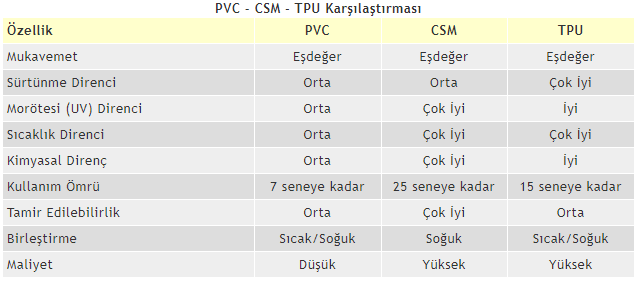
TPU-based fabrics can be considered roughly as a material positioned between PVC and CSM. A basic comparison of all three fabric types can be seen in the table below. It should be noted that there are many quality and price variations within each fabric type, and the table compares the highest-grade versions of each.
Contrary to common belief, tube fabrics are produced by combining multiple layers and have a multi-layer structure. Maximum airtightness and durability can only be achieved in this way. For example, a CSM (Hypalon)-based tube fabric consists of at least five layers, and only the outermost layer is CSM. The inner layers include neoprene and reinforcement (cord) fabric components. You can see the arrangement of these materials in the representative cross-section image below.

1) CSM (Hypalon) Outer Layer, 2) Neoprene bonding layer, 3) Neoprene inner layers, 4) Reinforcement fabric (usually polyester)
The most common reinforcement material used in tube fabrics is polyester, although other options exist when superior mechanical properties are required. This core polyester woven layer provides the fabric with physical strength and dimensional stability. Polyester weaving is typically used in 1,100 dtex, 1,680 dtex, and 1,870 dtex. Dtex is a textile unit indicating yarn thickness and represents the weight in grams of 10,000 meters of yarn. For example, 1,100 dtex means that 10,000 meters of yarn weighs 1,100 grams.
CSM (Hypalon), which has excellent chemical resistance and UV resistance and is also the most expensive component of the fabric, is used as the outermost layer. Neoprene is used as the bonding layer between the outer CSM layer and the central polyester reinforcement layer. The inner side consists of two layers of neoprene.
In PVC and TPU fabrics, the structure is simpler: a central polyester reinforcement layer with one PVC or TPU layer on each side, making manufacturing easier.
At this point, it is also important to mention the variables that determine the quality of the final inflatable product:
For all three fabric types, materials with varying qualities are produced by many manufacturers, and prices vary accordingly. Considering the highest quality materials available, the ranking from best to lowest for inflatable boat production is:
This ranking also reflects cost from highest to lowest. However, using low-quality CSM will not produce good results. Regardless of fabric type, material quality directly affects the outcome.
Inflatable structure manufacturing is labor-intensive, and workmanship quality is even more critical than fabric quality. This includes correct design and production using proper materials and techniques. Labor cost therefore has a significant impact on total cost, and insufficient workmanship cannot produce successful results.